THE TANK by
CARTIER
A rectangle, two parallel sides and a remarkably enduring identity: the Cartier Tank is a watch whose appeal begins with its shape. Created by Louis Cartier in 1917 and launched commercially in 1919, it has become a fascinating subject for collectors of twentieth-century design.
Here, we explore the Tank’s history through its changing forms and three watches at Hutchinson Scott: two recorded sales and an 18ct white gold example in our forthcoming Autumn Fine Interiors Auction.
A 1968 London-Hallmarked Tank with a Remarkable Story
1968
London hallmarksA watch with a story
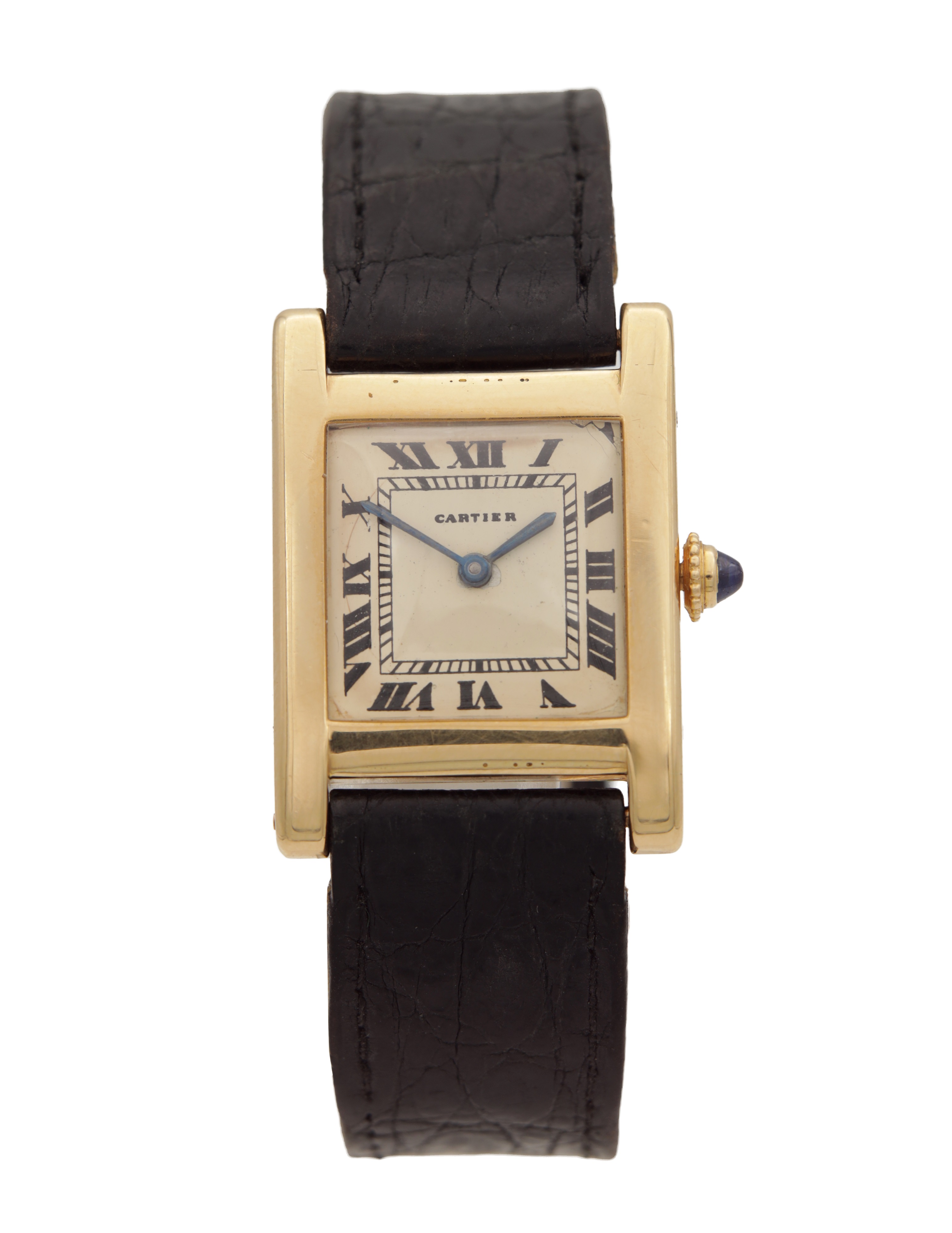
Lot 1148: Cartier 18ct Gold Tank
This 23mm-wide watch brought together familiar Tank details: a cream Roman numeral dial, blued steel hands and a cabochon sapphire crown. The catalogue recorded hallmarks reading “JC, London, 1968”, an alligator leather strap and an original 18ct gold deployant clasp.
Accompanying the watch was a handwritten letter of provenance stating former ownership by actor Stewart Granger. That is the specific claim recorded in the catalogue; the letter adds a personal thread to the object’s history without establishing which occasions he may have worn it on.
Sold for £18,500 on 16 April 2026.
The watch invites collectors to look beyond a model name and consider hallmarks, fittings and surviving documentation together. Its recorded result belongs to this particular example.
View Lot 1148 and Sale ResultWhy Is the Cartier Tank Called the Tank?
The name has a literal source. Cartier describes the watch’s outline as inspired by a military tank seen from above: the parallel sides suggest the tracks, while the central case echoes the vehicle’s body. Those side pieces are known as brancards, and they provide the frame around which the design is organised. See Cartier’s account of its signature designs.
The translation is striking. A machine associated with the First World War became the starting point for a small, precisely balanced object worn at the wrist. The appeal lies in the abstraction: you see proportion and geometry before you see the original reference.
Created in 1917, Launched in 1919
These two dates describe different moments. Louis Cartier conceived the Tank in 1917; its commercial launch followed in 1919. Cartier also records that the first prototype was presented to American General John Pershing. Its Tank collection history makes the distinction between creation and launch.
The side bars continue towards the strap attachments, helping case and strap read as a coherent whole. This relationship explains much of the design’s strength: even as dial treatments and proportions change, the outline remains recognisable.
What Makes a Cartier Tank Recognisable?
Compare the three watches illustrated here. The London-hallmarked example combines a pale dial with dark numerals; the vintage manual-wind watch replaces that graphic arrangement with a rich blue field; the forthcoming white-gold watch offers a different contrast between case and dial. The framing effect of the case ties them together.
Roman numerals, blued hands and a cabochon-set crown are familiar features of many Tanks, but they are not a checklist that every example must satisfy. Variations are part of the story. Nor can those details alone authenticate a watch: the case, dial, movement, markings and documentation need to be considered together.
How the Cartier Tank Evolved
The Tank is a family of designs rather than a single watch produced unchanged. Several turning points show how Cartier kept returning to its original idea.
1922: The Tank Louis Cartier
The Tank Louis Cartier dates to 1922. Cartier describes it as the successor to the original Tank, placing it at the heart of the family’s development. It remains a useful reference point when looking at the balance between the dial and the enclosing side bars.
1928: The Tank à Guichets
The Tank à Guichets, introduced in 1928, took a markedly different approach: time appeared through apertures rather than on a conventional dial with hands. It demonstrates how far the Tank idea could travel while retaining a distinctive case. Cartier revisits both these milestones in its watchmaking history accompanying the 2025 collection.
The Late 1970s: Colour and the Must Years
Cartier’s retrospective highlights monochrome dials during the Must years at the end of the 1970s. Colour offered another way to reinterpret the familiar frame. The blue-dial watch below makes an interesting visual comparison, although its catalogue does not identify it as a Must model or give a production date.
1996: The Tank Française
With the Tank Française, launched in 1996, a metal bracelet continued the visual line of the case. The family could now be read as an integrated bracelet watch as well as a watch on a leather strap. Read Cartier’s overview of the Tank’s evolving design.
Vintage Cartier Tank Watches Sold at Hutchinson Scott
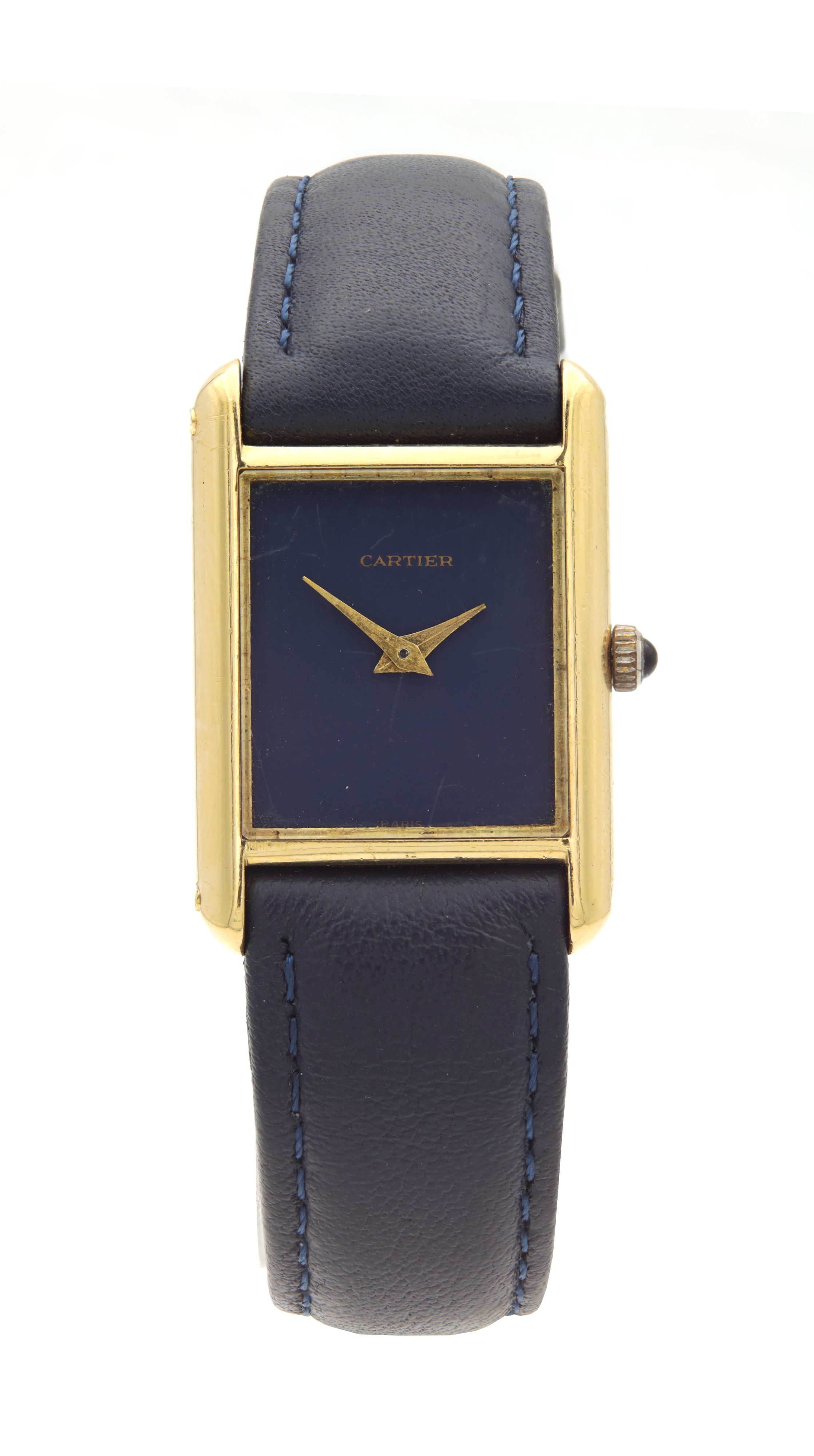
Lot 1220: Vintage 18ct Gold Cartier Manual-Wind Tank Watch
Sold for £2,300 · 22 January 2026
Lot 1220: Vintage 18ct Gold Manual-Wind Tank
A simulated lapis blue dial and gold hands give this example a very different character from the Roman numeral watch above. It was catalogued with a blue leather strap and a jewelled, spring-driven movement housed in a rectangular 18ct gold case.
Measuring 23mm wide, the watch carried a case-back engraving reading “Cartier, Paris. 20756294”. The catalogue’s wording is important: the dial was described as simulated lapis, not as natural lapis lazuli.
Sold for £2,300 on 22 January 2026.
View Lot 1220 and Sale ResultWhat Do These Cartier Tank Auction Prices Tell Us?
The £2,300 and £18,500 results illustrate why “What is a Cartier Tank worth?” needs an answer specific to the watch. Both were catalogued as 18ct gold Tanks, but their dials, details and accompanying histories differed. The results alone do not establish how much any single feature contributed to the final price.
Past results are reproduced as “sold for” figures from the linked catalogue pages. They are not presented as all-inclusive purchase costs or valuations for other watches.
A Cartier Tank for Sale: 18ct White Gold, Lot 444a
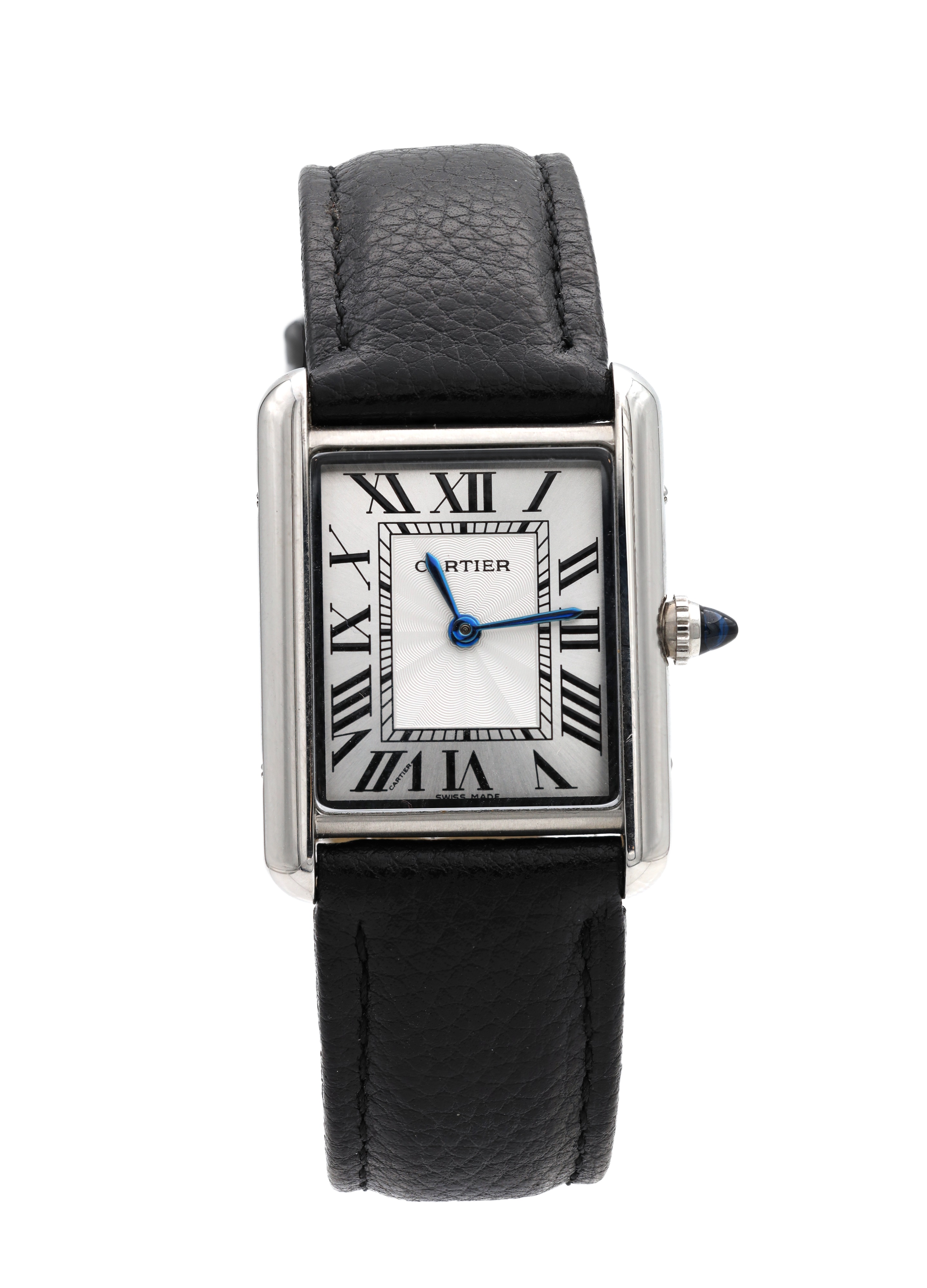
Lot 444a: Gentleman’s 18ct White Gold Cartier Tank Wristwatch
Estimate: £1,000–£1,500 · 14 October 2026
The Autumn Fine Interiors Auction
Our forthcoming example is catalogued as a gentleman’s 18ct white gold Cartier Tank wristwatch, on its original leather strap. A two-tone silvered dial with Roman numerals fronts a quartz movement, and the watch measures 26mm wide.
Estimate: £1,000–£1,500.
Scheduled for 14 October 2026, in the session beginning at 10am.
This is an upcoming lot, rather than a recorded sale. The session start is not an individual lot time. Open the live catalogue entry for current availability, further photographs, condition-report enquiries and registration.
The estimate excludes buyer’s premium and other applicable charges. Read the current fees and terms before bidding.
What to Look for When Buying a Vintage Cartier Tank
Read the Case and Dial
Study the proportions, hallmarks, signatures and case-back markings. Ask about dial restoration, replacement components and polishing. Record the dimensions: a photograph alone can make a modestly sized vintage watch appear much larger.
Understand the Movement
The featured watches include manual-wind and quartz examples. Check the catalogue for the movement type, ask about running condition and request any available service history. Plan for any maintenance identified before bidding.
Examine the Documentation
Boxes, papers, receipts and correspondence can add context. Read what each document actually establishes, and distinguish recorded provenance from an unsupported story. Compare the strap and clasp with the catalogue description too.
Request a condition report and arrange viewing through our Skipton auction team. Set a budget that includes the applicable fees and collection or delivery costs. For a broader explanation of assessment, see our guide to antique valuations.
Cartier Tank History and Auction FAQs
When was the Cartier Tank invented?
Louis Cartier created the design in 1917. Its commercial launch followed in 1919, which explains why both years appear in accounts of its history.
Are all Cartier Tank watches mechanical?
No. The family includes different movement types. Our featured vintage blue-dial watch was catalogued as manual-wind, while the forthcoming white-gold example has a quartz movement.
How much does a Cartier Tank sell for at auction?
There is no single price for the whole family. The two past examples featured here have recorded results of £2,300 and £18,500. Model, materials, originality, condition and documented history all need individual assessment.
Where can I find a Cartier Tank at auction?
Follow the link to Lot 444a above for the forthcoming watch, or visit our watches department to explore further auction opportunities. Availability changes as sales take place.
How can I sell a Cartier Tank watch?
Start with our online valuation form. Include clear photographs of the dial, case back, hallmarks and clasp, together with dimensions and details of any box, papers or service records. Our team can advise on auction suitability and an estimate.
Explore Cartier Watches at Hutchinson Scott
The Tank’s history is told through individual watches as well as celebrated designs. Whether you are researching a family watch, considering selling or looking for an example to wear, our team at Embsay Mills, Skipton, can help you take the next step.
Historical sources are linked within the article. Lot descriptions, results and upcoming sale details were checked against the Hutchinson Scott catalogue on 24 September 2026. Consult the individual lot pages for updates.